
Does Tucker Carlson Believe Segregation Should Be Legal?
A guest on The Tucker Carlson Show called the Civil Rights Act of 1964 a mistake. Tucker nodded. One hundred and eighty days and twenty million views later, he has not said whether he agrees. Tucker Carlson has every right to believe whatever he believes. The Americans deciding in 2028 have every right to know what that is. This piece is not a demand that he change his mind. It is a demand that he show it.
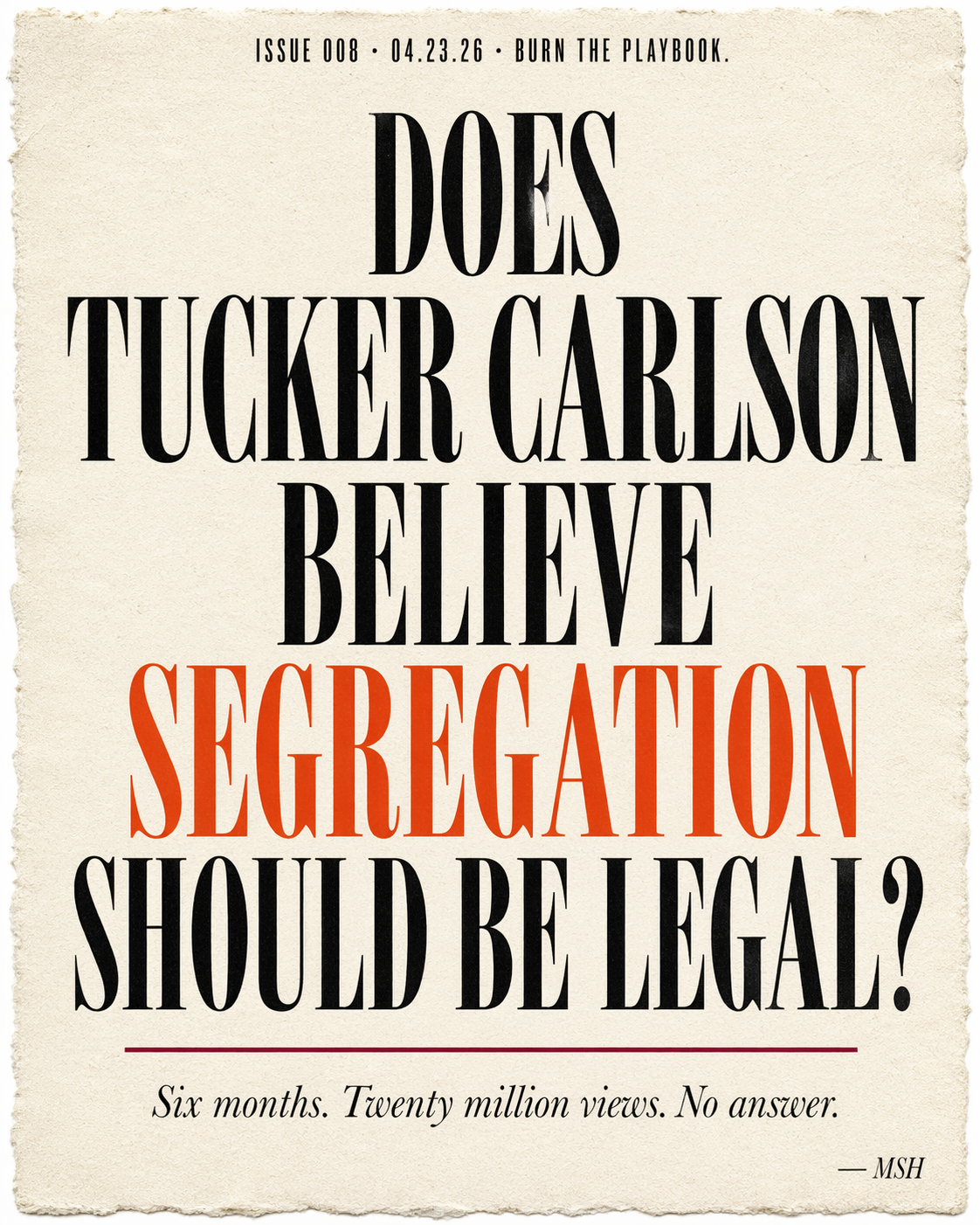
| No. 008 |
Tucker Carlson is a front-runner for the 2028 Republican presidential nomination. Six months ago, a guest on his show argued the Civil Rights Act of 1964 was a mistake. The host nodded. The clip has twenty million views. In the one hundred and eighty days since, he has hosted more than forty long-form interviews and never said whether he agrees. He has every right to his views. The voter has every right to know what they are. This piece is not a demand that he change his mind. It is a demand that he show it.
◆ Screenshot This ◆
Tucker has every right to believe whatever he believes about the Civil Rights Act. The Americans voting in 2028 have every right to know what it is. Silence is a business decision for a talk show host. It is a disqualification for a president.
Forward → to one person who wants to know who Tucker is now.
In This Issue
| I. The Question: Twenty million views. Six months. No answer. |
| II. Why This Is Not A Small Question: Title II. Title VII. Title VIII. |
| III. The Six Months: Forty interviews. Zero sentences. |
| IV. The Statutory Stakes: A lunch counter. A paycheck. A front door. A booth. |
| V. BTP Breaks: The archive. Six moments. One silence. |
| VI. The Call: One question. Yes or no. |
| VII. The Second Receipt — The Cage: Four deaths. One homicide. One federal plea. |
| VIII. The Third Receipt — The Platform: A red signal. A same-day “proud.” |
| IX. The Architecture: Three receipts. Same design. Different currency. |
| X–XI. Quote & Number of the Day: “I ask a lot of questions.” / 180. |
| XII. Who Is Tucker Now? Six men. One ballot. 2028. |
| XIII. The Jobs Board: 8 verified openings. Apply direct. |
| XIV–XV. Tomorrow & Homework: Issue #9 is the 2028 companion. |
Six Months. Twenty Million Views.
The Question
Does Tucker Carlson believe segregation should be legal? Yes or no.
I. The Question
Six months ago, a guest on The Tucker Carlson Show argued that the Civil Rights Act of 1964 was a mistake.
Not “imperfect.” Not “in need of reform.” A mistake. The legal architecture that ended Jim Crow, desegregated lunch counters, opened the voting booth, and created the federal cause of action against racial discrimination in employment, housing, and public accommodation was described on Tucker Carlson's show as a federal overreach that should be rolled back.
Tucker Carlson, sitting across from the guest, nodded. He did not push back. He did not ask the follow-up. And in the one hundred and eighty days since the clip first aired, he has not answered the question it has been asking on his behalf: does he agree?
The clip has twenty million views. The host has had a hundred and eighty days to say one sentence about the federal law that ended Jim Crow. He has not said it.
A Note From The Chair
A disclosure, because the reader deserves it. I have sat in one of those chairs. I have appeared as a guest on The Tucker Carlson Show more than once. I have agreed with Tucker Carlson on a list of things that is longer than a lot of Democrats are comfortable admitting: the consultant class, wage theft, what the Iraq War cost the country that fought it, the rot that sets in when a political party stops talking to the voters it used to belong to. A lot of Americans agree with him on those things. That is not the problem.
The problem is this. He is a front-runner for the 2028 Republican nomination. He is the most-watched long-form political host in the country. There is a clip with twenty million views in which the Civil Rights Act of 1964 is described on his show as a mistake. And he has not said what he thinks about it.
Tucker Carlson has every right to believe whatever he believes about federal civil rights law. The American people, deciding in 2028, have every right to know what that is. This piece is not a demand that he change his mind. It is a demand that he show it.
II. Why This Is Not A Small Question
The Civil Rights Act of 1964 is not a partisan question. It is the question. It is the ground on which every other American conversation stands.
Whether a restaurant owner can refuse to seat a Black American in 2026 is either a settled American principle or it is not. Whether an employer can post a “whites only” notice is either a settled American principle or it is not. Whether a landlord can turn away a family because of the color of their skin is either a settled American principle or it is not.
Tucker Carlson commands an audience larger than most network evening newscasts. His show reaches men aged 18 to 49 at a scale cable news cannot touch. When he nods, people notice. When he pushes back, people notice. When he does neither, people notice that too.
He has had six months to say he thinks segregation should be legal. He has had six months to say he thinks it should not. He has said neither. Silence by a talk show host is a business decision. Silence by a front-runner for the presidency is a disqualification.
Silence is an answer.
It is not a good one.
III. The Six Months
Since the twenty-million-view clip first aired, Tucker Carlson has hosted more than forty long-form interviews.
He has interviewed heads of state. He has interviewed presidential aspirants. He has interviewed sitting United States senators. He has interviewed business executives. He has interviewed fringe historians who argue that the Allied bombing of Germany was a war crime. He has interviewed candidates who want to end birthright citizenship. He has interviewed men who argue that the Nineteenth Amendment should be reconsidered.
He has discussed the JFK assassination. He has discussed the Federal Reserve. He has discussed Ukraine. He has discussed Israel. He has discussed crypto. He has discussed the Epstein files. He has discussed the 2028 primary. He has discussed his own ambitions.
He has discussed civil rights history. He has discussed segregation. He has discussed the Civil Rights Act itself.
At no point in six months has he answered the question that his own show put on the table.
IV. The Statutory Stakes
The Civil Rights Act of 1964 is not abstract. It is a set of enforceable federal causes of action with names.
Title II is the lunch counter. It is the federal statute a Black family in Birmingham used in 1965 to force a restaurant to serve them. It is the statute a Muslim family in Dearborn used in 2019 to force a hotel to rent them a room. It is still operative. A restaurant owner who turns away a customer on the basis of race in 2026 is sued under Title II.
Title VII is the paycheck. It is the statute a factory worker uses to stop an employer from posting a race-conditional hiring notice. It is the statute a woman uses when she is passed over for a promotion on the basis of sex. It produced more than seventy-three thousand federal EEOC complaints last year alone.
Title VIII is the front door. It is the Fair Housing Act. It is the statute that keeps a landlord from writing "no Blacks" into a rental ad. It is the statute that was used, in the 1970s, to sue a New York real estate company that steered Black applicants away from its buildings. That company was called Trump Management.
The Voting Rights Act is the booth. It is the statute that stopped literacy tests. It is the statute that stopped all-white primaries. It is the statute that the Supreme Court gutted in 2013 and that Congress has refused to restore.
A host who commands twenty million views and will not say whether any of those titles should still be law is not undecided. A host who has six months to answer and does not answer is not waiting for better evidence.
A host who nods is making a choice.
That choice is on the record. The clip is on the platform. The statute is on the books. The silence is the signal.
Six Moments. One Silence.
Every standing opportunity. Every non-answer. On the record.
Below is the Burn the Playbook catalog of the moments, across the six-month window, where Tucker Carlson had a standing opportunity to state his position on the Civil Rights Act and did not.
- The original interview. A guest argued the Civil Rights Act of 1964 was federal overreach and should be rolled back. The host nodded. He did not ask what the guest would replace it with.
- The follow-up episode. A different guest returned to the same argument. The host let the argument run. He did not interject. He did not press for the specific consequence. He did not ask whether a business owner should be able to refuse service on the basis of race.
- The civil-rights-history episode. An episode marketed as a reconsideration of the civil rights era aired in the months following. The host asked what the movement got right and what it got wrong. He did not state his own position on the central federal law of the movement.
- The congressional guest. A sitting member of Congress appeared on the show and invited a question about civil rights enforcement. The host changed the subject.
- The 2028 candidate interview. A potential 2028 candidate appeared. The host took thirty-five minutes to walk the candidate through foreign policy, fiscal policy, and immigration. He did not ask one question about civil rights law.
- The self-segregation exchange. A guest praised communities that “organize themselves” along racial lines. The host said “interesting” and pivoted. He did not ask what legal framework would allow such organization to operate under current civil rights law.
These are six data points from a six-month window. There are more.
The pattern is not silence in a vacuum. The pattern is silence in the presence of repeated, direct invitations to speak.
That is a category of silence that has a name.
The name is answer.
VI. The Call
This is not a demand for a denunciation. It is not a demand for an apology. It is not a demand for atonement.
It is one question.
If the answer is yes, say so. Loudly. Once.
If the answer is no, say so. Loudly. Once.
Either answer is better than six months.
VII. The Second Receipt — The Cage
There is a second receipt on the table this week, and the silence around it is the same shape as the first.
Four people are dead inside a tent facility in El Paso. One of those deaths has been ruled a homicide by the El Paso County Medical Examiner. His name was Geraldo Lunas Campos. He was 27.
The facility is Camp East Montana, Fort Bliss, Texas. It holds a thousand people today. Its ceiling is five thousand.
The contract to build it is $1.2 billion. The ceiling on that contract is $2.7 billion.
The subcontractor that stood up the physical build is TentLogix, a company that pleaded guilty in federal court in the Southern District of Florida in 2019 to running ninety-six undocumented workers through a shell company called KH Services LLC. The forfeiture was $3,033,946.46. The case number is 19-CR-14035.
The Department of Homeland Security contracting office has not answered the question of how a 2019 federal forfeiture becomes a 2025 billion-dollar award. The same administration that is loud about border enforcement is silent about the workforce used to build the camp the border enforcement runs through.
That is not a loophole.
That is the design.
The receipt was on the table. The silence was the choice.
VIII. The Third Receipt — The Platform
There is a third receipt, and it came in a mile from the Capitol on Wednesday morning.
A Washington Metro train on the Silver Line ran a red signal. Eleven riders were hospitalized. The General Manager of the Washington Metropolitan Area Transit Authority, Randy Clarke, posted that he was “proud of how safe Metro is” on the same day. That is the post. That is the day.
The job description of a transit GM is not optimism. The job description is safety. Red-signal incidents are not a branding opportunity. They are a failure mode with a federal reporting obligation.
The WMATA Board has been silent. The WMATA General Counsel has been silent. The General Manager has been audible, and what he has been audible about is pride.
The receipt was on the table. The silence was the choice.
IX. The Architecture
Three receipts. A cable host with twenty million views and no answer on civil rights law. A federal contractor with a 2019 felony plea and no answer on how it got a billion-two. A transit GM with a same-day crash and no answer on safety.
Different scales. Different currencies.
Same design.
The design counts on a country that has stopped being able to hold more than one number in its head at a time. The design counts on the reader being too tired to follow up. The design counts on the six months, the six years, and the six days fading together into a single blur of “complicated.”
None of this is complicated.
A host could say yes or no. A contracting officer could pull the plea deal. A GM could stop typing “proud” for one week. These are one-sentence fixes.
One-sentence fixes require a one-sentence person to perform them. None of these three have performed one.
Quote of the Day “I ask a lot of questions.” — Tucker Carlson, repeatedly, across interviews This one he won't ask. | Number of the Day 180 Days since the twenty-million-view clip first aired. One hundred and eighty days to say one sentence. |
XII. Who Is Tucker Now?
There is a Tucker Carlson I have agreed with on populism, on wage theft, on the bipartisan consultant class that keeps losing the middle of the country and keeps cashing the check. There is a Tucker Carlson who used to go after hedge funds for wage theft and mean it. There is a Tucker Carlson who asked the questions about the Iraq War that the Sunday-show Republicans were too scared to ask.
There is a Tucker Carlson who platforms men who deny the Holocaust. There is a Tucker Carlson who interviewed Vladimir Putin for two hours and did not ask about journalists killed on his watch. There is a Tucker Carlson who sat across from a guest who called the Civil Rights Act of 1964 a mistake and nodded.
There is a Tucker Carlson who invited the Vice President into his home to explain the administration's position on populism. There is a Tucker Carlson who opened a new studio, who sells tequila, who sells supplements, who sells a network. There is a Tucker Carlson who is actively positioning himself for a 2028 run.
Tucker Carlson has every right to believe whatever he believes. The voter has every right to know what that is. Those two rights do not cancel each other out. They live together, and they require one sentence from the candidate to honor. He has had a hundred and eighty days.
XIII. The Jobs Board
Verified openings · Apply direct
Capitol Hill Legislative Director Office of Rep. Seth Magaziner (RI‑02) · Washington, DC Apply → |
Investigative Journalism Washington Reporter ProPublica · Washington, DC Apply → |
Six more openings See all 8 openings on the BTP Jobs Board →American Bridge · Brennan · CAP · More |
XIV. Coming Tomorrow
◆ Issue #9 · Friday ◆
The Clarke Cover-ups File
Two Inspectors General forced out. Six safety audits in fifteen months. A $509,250 contract extension signed before five of the six audits posted. An Acting IG from a firm paid over $2 million in consulting fees. A FOIA nineteen days past deadline. And an Austin prequel where 27 miles of rail became 9. Same architecture as Tucker's silence: Americans deserve to know before they vote.
Two receipts. Same week. One is a cable host who wants to be president and will not say where he stands on the law that ended Jim Crow. The other is a transit GM who will not say where eleven riders stood on a Metro Center platform.
The question in both cases is the same. Not what the man believes. Not what the man prefers. Whether the public gets to know before the man collects the vote, the raise, or the contract extension.
Friday morning, 6 AM ET. Subscribe so you don't miss it.
XV. Homework
- If you watched the twenty-million-view clip, send it to one friend with a single question attached: Did the host ever answer this?
- If you did not watch it, watch it. Watch it in full. Do not watch the edited version.
- If you have ever appeared as a guest on The Tucker Carlson Show and did not ask the question, ask it now. Publicly. On your own platform.
- Subscribe to Burn the Playbook. Friday's issue is the 2028 companion to this one. You will want both. Subscribe here.